

Discomfort aversion
Are we taking the easy way out?

It’s almost daylight savings time, which means this about that time of year where my seasonal depression kicks in and I get a light touch of agoraphobia. I marvel at friends who can spend the entire day away from home, bouncing from one activity to the next, when the thought of doing so myself often fills me with dread. I’ve come to realize that I’m not the only one, that it seems to be part of a growing behavior shift amongst younger generations. Which leads me to this article — equal parts a cultural commentary and an introspection exercise. Enjoy :)
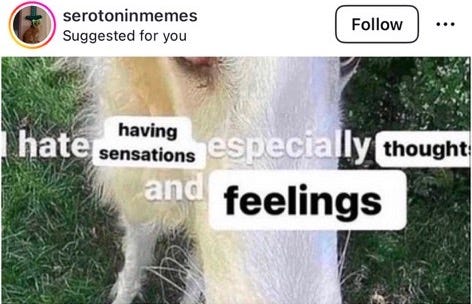
Raised in the era of the internet, hidden behind the safety of the screen, Gen Z is arguably the first generation to possess the ability to avoid discomfort almost entirely. The real world is scary, and it’s easier than ever to simply opt-out. In many ways, young people are doing what they have been endlessly nagged to do — keep their heads down, stay out of trouble and concentrate on their homework. But perhaps it has gone too far.
“Protecting my peace” has led to completely abstaining from the challenges of normal everyday life. It’s one reason perhaps why younger generations are reportedly struggling to make friends and find partners, unable to meet the demands of a basic 9-5 job, and bed-rotting at home instead of going out.
Some of this is warranted. With post-pandemic dread, climate anxiety and political turmoil, the barrier of a screen can be incredibly comforting. But while we become seemingly trapped in the digital realm, our real life social skills are atrophying. From 2003 to 2022, American adults reduced their average hours of face-to-face socializing by about 30%, a number that is expected to continue to rise. IRL interaction becomes that much harder when most of your social and professional life happens on a screen. A recent survey found that more than 50% of Gen Z respondents say yes, their social skills are getting worse. Older generations would concur — 62% of education leaders reported student’s ability to make and maintain eye contact has worsened compared to 10 years ago.
Rather than push through the awkwardness of meeting new people, it’s leading to a loneliness epidemic. Many have argued that due to shifts like American suburbanization and the rise of social media, third spaces which were once fertile ground for building those connections have disappeared. But even if they existed, would people even go?
“Are third spaces dead, or our social skills?” asked Matt Klein on Linkedin.

Something that digital spaces have done to wreck the appeal of physical spaces, is creating the illusion of a controlled environment. “It’s clear that we’ve become accustomed to a digital-world tailored specifically to us,” writes Anna Pompilio for Midwest Aesthetic. “Our likes, our dislikes, our values, even our aesthetics. Our right, our wrong. And with in-person social skills diminishing, it’s easy to say that we’ve moved there. Digital-World is World.” Why risk a much less controlled environment in the “real” world, and the discomforts that come with it?
The deterioration of social skills is having an indelible impact for younger generations in the workplace. 6 in 10 employers said they have fired Gen Z college graduates who they hired in 2024, citing reasons like that they were grossly unprepared to do the job at hand, genuinely not wanting to do the work, or being unprofessional with poor communication skills. It’s hard to ignore the larger macroeconomic forces that may be having an impact on this — stagnant wages, massive layoffs, and skyrocketing inflation have all made today’s youth disenchanted with the corporate world. And employers may already be primed with stereotypes that Gen Z is lazy or uncooperative in the workforce.
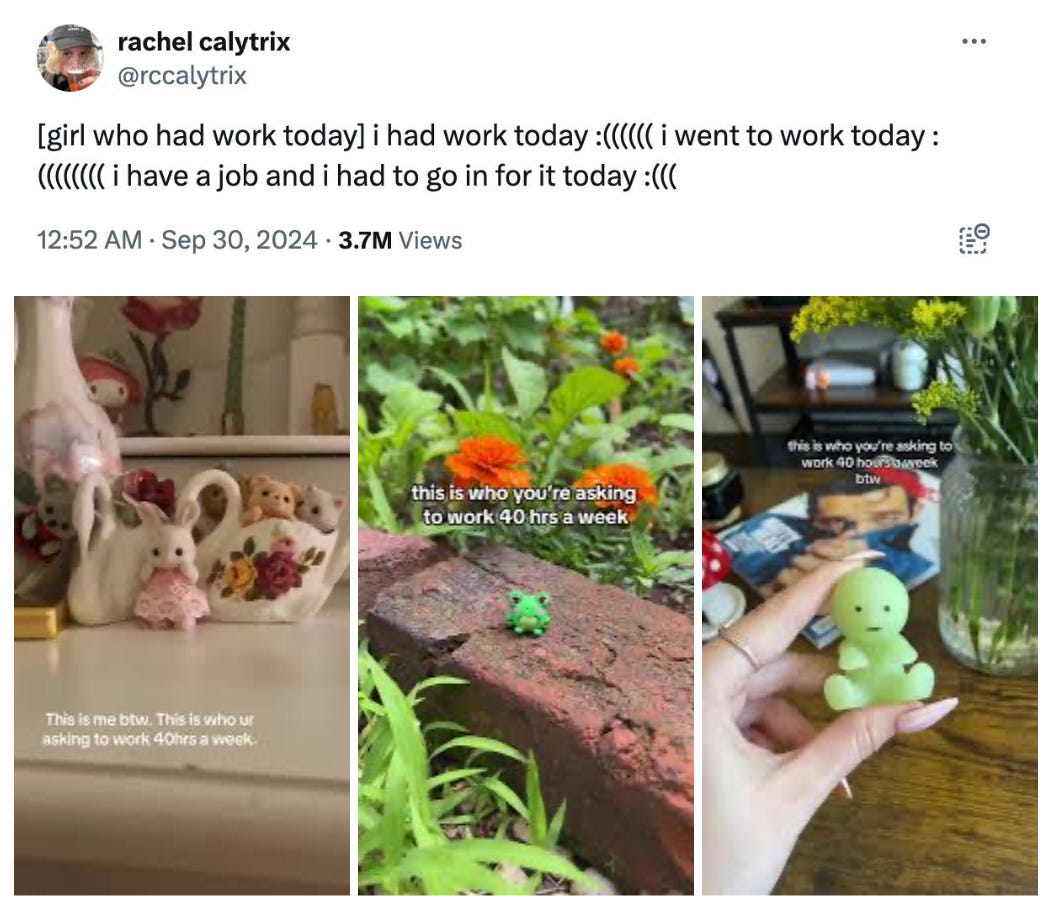
But online, young professionals aren’t really trying to prove otherwise. From searching for dumb jobs to practicing fauxductivity, quiet quitting and quiet vacationing, the goal seems to be to shirk as many responsibilities as possible. After all, it’s comfier to just stay at home. How dare you ask me, a little frog, to work 40 hours a week.
Even the concept of “going out” seems to have lost its appeal with younger generations. In Australia, one survey found 71% of Gen Z had cut back on going out. Concern about “reclusive youths” who rarely leave their homes prompted South Korea’s government to propose a monthly allowance of $490 in an attempt to reintegrate the “hermit-like young.”
Despite the allure of trends like hot girl, feral girl and brat girl summers, today’s young people are increasingly opting to stay home — watching their nightlife fantasies play out on TikTok from the safety and comfort of their bed. “In these isolated and controlled environments, our mistakes can be made in private, our public images can be meticulously managed, and our personal boundaries stay comfortably intact.” writes steph :) about gen z’s party recession. At home, we can avoid the loud music, rude bouncers, creepy guys, and dreaded hangovers. We’ve gone from Millennial FOMO to Gen Z JOMO. But are we missing out on too much?
Perhaps this shouldn’t be so surprising. Dating apps and Snapchat mean we don’t have to leave the house to socialize or find a partner. Netflix and TikTok provide endless entertainment at our fingertips. DoorDash and UberEats remove the friction that comes with going out to a physical restaurant. And with the increased emphasis on mental wellness above all else, a night at home holds more value than it may have for previous young generations.
Chappell Roan’s abrupt concert cancellations started a conversation about the increased emphasis Gen Z places on mental health. Many feel that Roan, and by extension younger generations at large, need to stop using mental health as an excuse. Mental health SHOULD be prioritized but not to the point where we’re stuck in a little glass bubble. Of course, Roan’s situation has several other cultural dynamics at play — namely intensifying parasocial relationships and the fetishization of celebrities. But there’s a kernel of truth in there for young adults today — that sometimes we just have to suck it up and do the hard thing.

Because despite the positive discourse on mental health in the last decade (much needed), the exaggerated emphasis may have blurred the line between true mental illness and the normal stressors of an average life. Distinguishing between what we should be avoiding for our mental health, and what we need to confront for our own personal growth has gotten challenging, particularly as there’s always an easy out (stay at home and abstain from everything while you rot in bed on your phone). Brianna West, author of 101 Essays That Will Change The Way You Think, writes “discomfort is what happens when we are on the precipice of change. Unfortunately, we often confuse it for unhappiness and cope with the latter while running from the former.”
There’s a lot of variables at play when it comes to discomfort aversion amongst young generations. But it’s impossible to ignore the common through line — that there are many areas of life in which we may be making more excuses for ourselves than we should. We deserve a comfortable and safe life, but not at the expense of our personal growth. Being young should feel uncomfortable and awkward as hell. As a young millennial, I don’t know who I would be without those weird middle school and high school years.
Algorithmic perfection creates a compelling digital world, but risks lulling us into a false sense of comfort, stuck in soothing aesthetic bubbles. Real life is messy, unpredictable, nuanced and oftentimes scary. But if social media has numbed us to doing challenging things, we need to actively work to break out of that.
Been thinking these sorta things lately. Thanks putting it into words :]