

Things aren’t that bad
Time for a reality check

My grandma was one of the happiest people I’ve ever known, despite having had an incredibly challenging life. First and foremost, she grew up during the Great Depression. Then, her 9th birthday party was unceremoniously cut short due to the bombing of Pearl Harbor. Later in life, her daughter (my aunt) suffered from both epilepsy and schizophrenia during a time where very little was known about either. In her 50s, she contracted Guillain-Barré syndrome, was paralyzed, and literally had to relearn how to walk. Still, amidst these and countless other hardships, my grandma as I knew her was always smiling, cheerful, grateful.
I do not think people today have that type of resilience. I certainly do not have it. I think about her often on days when I am crashing out because work was stressful or because I sprouted a painful chin pimple the day before a big event. She would probably laugh at me, then tell me to get over it and get on with my life.
The reality is that if you ask anyone roughly between the ages of 20-40 these days, they’d tell you that things are pretty bad. Honestly, even my Boomer mom has been catastrophizing things lately. The government has gone to shit, the economy is crumbling, the planet is dying, and the kicker is that AI is going to take all our jobs. People are cynical about the present and pessimistic about the future. They’re concerned for themselves and for their neighbors. They’re hyper-aware of every crisis and simultaneously convinced they can do very little about any of them.

Sam Peltzman from the University of Chicago found that after 50 years of mostly steady levels of self-reported well-being, the country has experienced “a sudden, sharp and historically unprecedented decline in self-reported happiness,” in the five years since the pandemic, across “nearly all typical demographics and geographies.”
Which is wild because despite the fact that society occasionally appears to be regressing, many things have drastically improved over the last 50 years. Rates of teen pregnancy, domestic abuse, traffic deaths, and violent crime have plummeted to historic lows. Scientists have eradicated diseases, reduced child mortality, extended lifespans, and turned many once-deadly diagnoses into survivable ones. There are many good things happening, but we’ve become steadfast in our focus on the negative — so stubbornly fixated on what’s wrong that all we let ourselves see are the cracks.
Take the economy for instance. “Americans Refuse to Be Happy,” The Atlantic declared last month, describing how households now feel worse about their finances and the broader economy than they did during the Great Inflation of the 1970s, the Great Recession, or the early pandemic, despite the fact that 96 out of every 100 Americans who want a job have one and real disposable income is at a record high. “People have stopped believing that the economy can be good, and have lost the willingness to admit that they are doing well.” writes Annie Lowry.

Yes, we have rising costs of living, stagnant wages, and an increasingly visible wealth gap. But every generation has had to deal with some level of economic precarity, amongst countless other societal issues. The question isn’t whether modern life has problems. It clearly does. It’s that why, despite so many objective improvements across the basic measures of human well-being, does the prevailing mood remain one of despair?
What makes us feel so entitled to a perfect utopia?
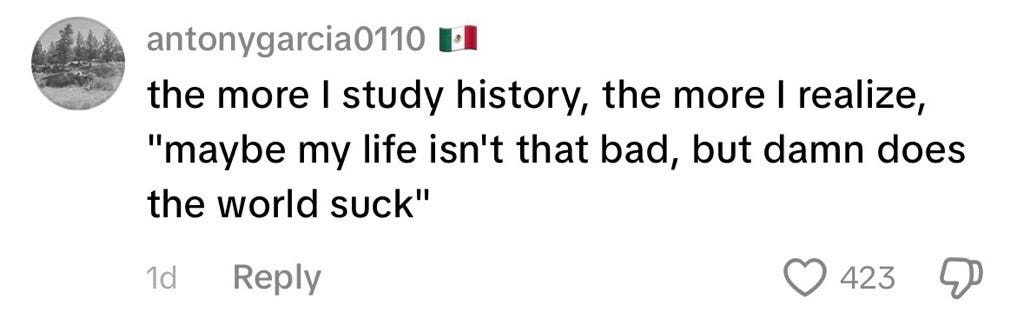
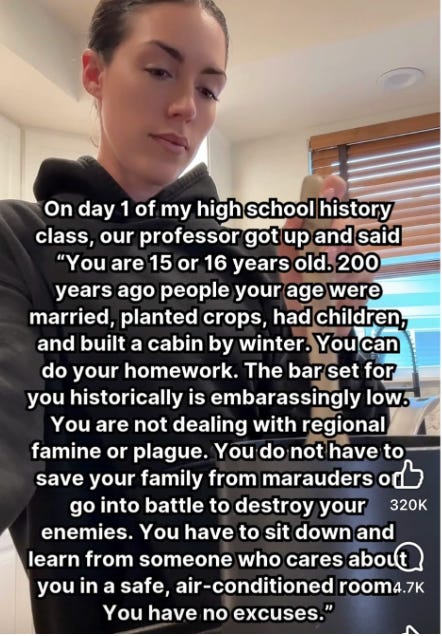
As far as historians can tell (and based on those AI-generated historical POV videos I’ve become weirdly addicted to), being a human being on planet Earth has always been really fucking hard. Every generation has had to deal with unprecedented events. The introduction of life-altering technology. Fascist dictators. Even their own pandemics! It might be somewhat narcissistic to think that things are the worst they’ve ever been. Especially when it leads to an unhealthy over-romanticization of the past, as younger generations are wont to do. As if being a 1950s housewife would not come with the drawbacks of, well…being a 1950s housewife.
In the U.S., we are no longer child brides. We are not susceptible to dying on the Oregon trail from dysentery, or victims of devastating famines. We can treat winter like a cute cozy seasonal occasion rather than an ominous period of darkness for which we need to stockpile wheat. Our needs today are largely confined to the upper tier of Maslow’s hierarchy, which, while they are more difficult to achieve, are much less urgent to our literal survival.
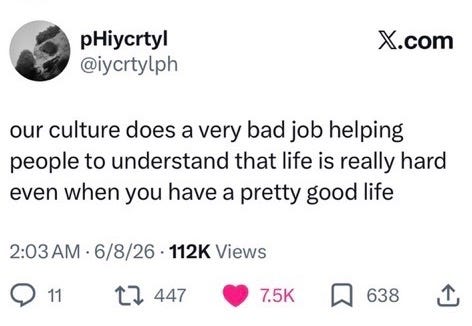
To answer my previous question, I don’t think these bad vibes about life are driven as much by the reality of structural issues like inequality and housing prices as they are by our social media feeds. In an age of hyper-visible billionaires, influencers and the internet, this illusion of a perfect utopia feels strangely attainable, yet still painfully just out of reach. We’ve been conditioned to believe that life should always be easy (convenience culture taught us that), aesthetic (influencer culture taught us that), and personally fulfilling (main character syndrome taught us that 👀). Everything looks better on social media, and so it can seem like some people are living the perfect utopian dream (Pookie’s month-long babymoon in Italy honestly feels like a dream come true to me, minus having to spend all that one-on-one time with Jett). But that is rarely the case.
Then, on the other hand, online we are exposed to the horrors of the world more than people in previous generations ever were. That has been well discussed. But I think the real trouble with the vibes is that every time we see something B.A.D. on our feeds, we also see something unrealistically good. The extremes of algorithmic social media can simultaneously make us feel like everything is awful while at the same time that everyone is thriving, which creates this very uncomfortable psychological whiplash. Here’s war, here’s a protest, here’s a DITL of someone living in their car and WOW now here’s a lavish brand trip to Turks & Caicos! The reality is something in the middle — things are rarely all that good, and rarely all that bad.
To make matters worse, this kind of nihilistic misery has become performative. A sort of status-signaling. For a generation that romanticizes mental illness, aestheticizes struggle, and films their breakdowns for content, being upset about the state of things might be kind of…chic? After all, if you aren’t consistently horrified by what’s going on in the world, do you even have a conscience? We proudly wear our mental health diagnoses as personality traits, and feel emboldened to ask happy people we come across online “how much lexapro ru on bro.” I mean, how are you NOT on SSRIs given all that’s happening in the world? This cynicism has quickly morphed into a competitive race to the bottom, as if your ability to identify the rot in everything is evidence of some moral superiority.

Our progressive impulse to challenge the status quo and demand better are admirable, and we should keep doing it. But chronic despair isn’t activism. It’s just despair. And that despair is making us less equipped to handle everyday challenges and more inclined towards resigned languishing.
I think about how my grandma and countless others in her generation got through what they got through. It was certainly not because she was naive about how hard things were — she knew better than most — but because she understood something that I think our generation is slowly unlearning: that your disposition towards life is, to some extent, a choice. Not a toxic positivity “good vibes only” choice. A quiet, daily, unglamorous one.
Our lives are not that bad, and it’s not just because others in the past had it comparatively worse. It’s because we were tricked into thinking life should not have any challenge in it whatsoever. Life is hard, it has always been hard and it always will be hard. Isn’t that the point? The challenges of life are what make it meaningful, and the utopia we seem convinced others have found is not even one we would want to live in. A perfect life is an empty one.
The impetus for younger generations today is not to fixate on everything that is wrong with the world and with their lives. It is to find ways to live a happy life despite all of it.
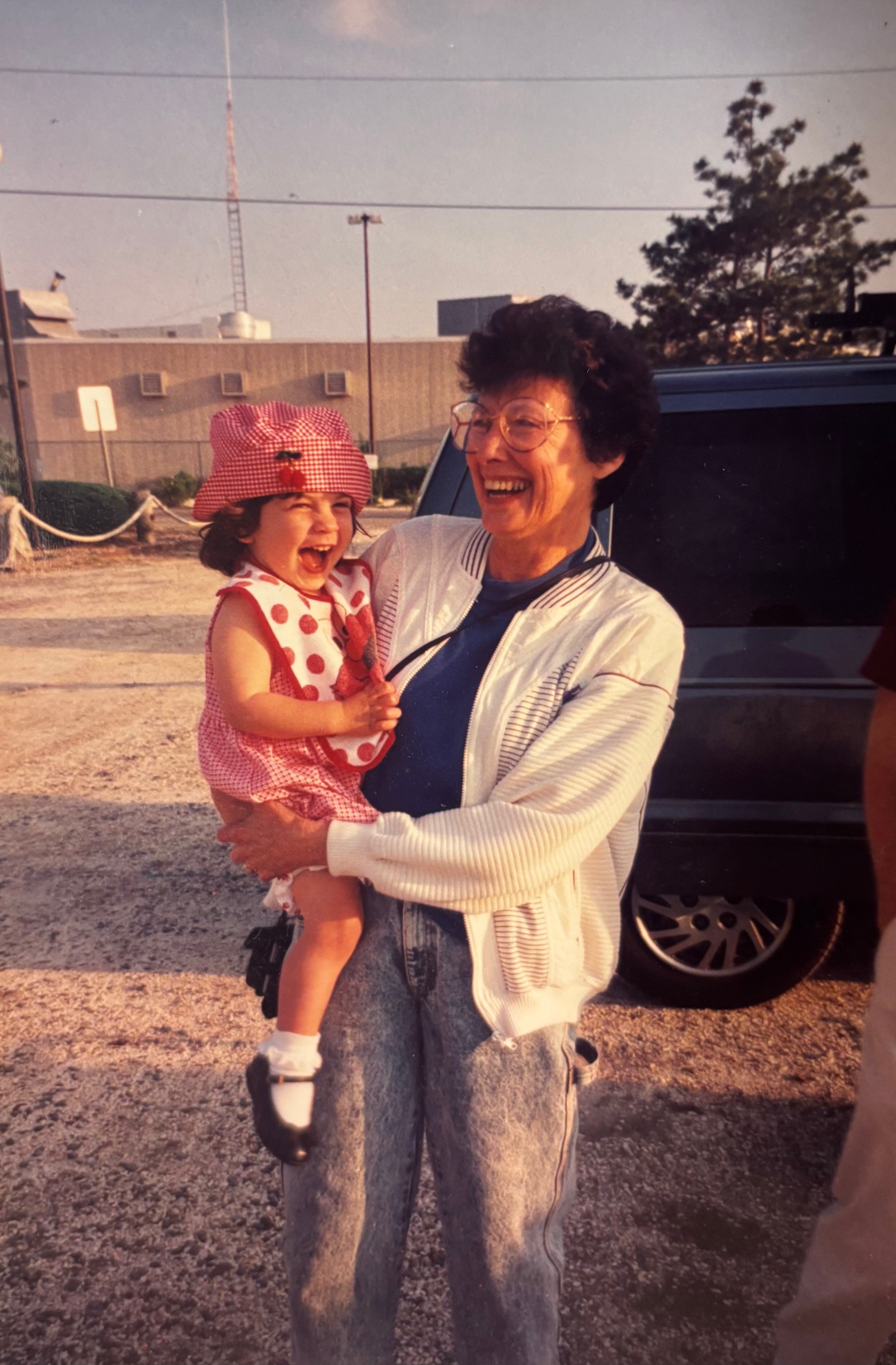
Grandma always found the silver lining!
IMHO, I think we are a victim of our affluence. Your grandmother, my mother, and even me to some extent (I am 54) learned early on to deal with some level of hardship… my level of hardship was minor compared to my mother, and hers was minor compared to her mother. But still… if I go back to being 8, there was no snacking between meals, food was eaten at the table, you ate what was on your plate, TV was limited to Saturday morning cartoons, homework was assigned and graded, boredom was a part of childhood that forced us o become creative, and long car rides didn’t come with snacks and entertainment. It was not a horrendously difficult time to be a child, but it still required me to live with discomfort, to be pleasant even if I was mad, to be polite, and any temper tantrum was quickly resolved by a smart smack on the tush to remind me that I was not at the center of the universe. (Not a beating, it didn’t really hurt, it was more of a reboot to the system. Pay attention and behave yourself)
I am a substitute teacher in elementary school and I see how very little discomfort kids deal with today. They each have gigantic water bottles, so they don’t even have to get a little thirsty, they get a snack break, they don’t have to wait in between classes to go to the bathroom, homework is rarely assigned, and only graded on vague effort, they don’t have to deal with the humiliating experience of being publicly graded, their homes are filled with toys and screens, they don’t even have to wait until Saturday to watch a cartoon, their favorite is available to stream at any time. Their Spotify playlist is curated to such an extent that they don’t have to listen to music that they don’t like (remember the 80’s when there would be a song that would get so much airplay and it was like… please, make it stop… and so it did, all original music stopped). They don’t even have to get in the car for an hour drive to grandma’s house without mom packing a bagful of snacks to keep them entertained along the way.
It feels like a Princess and the Pea generation… they are uncomfortable with everything because they have never developed the skills necessary to handle the little inconveniences of life, and they don’t even have the good manners to keep their discomfort private, they have to create a spectacle of their tantrums… and there is no one around the reboot the system.